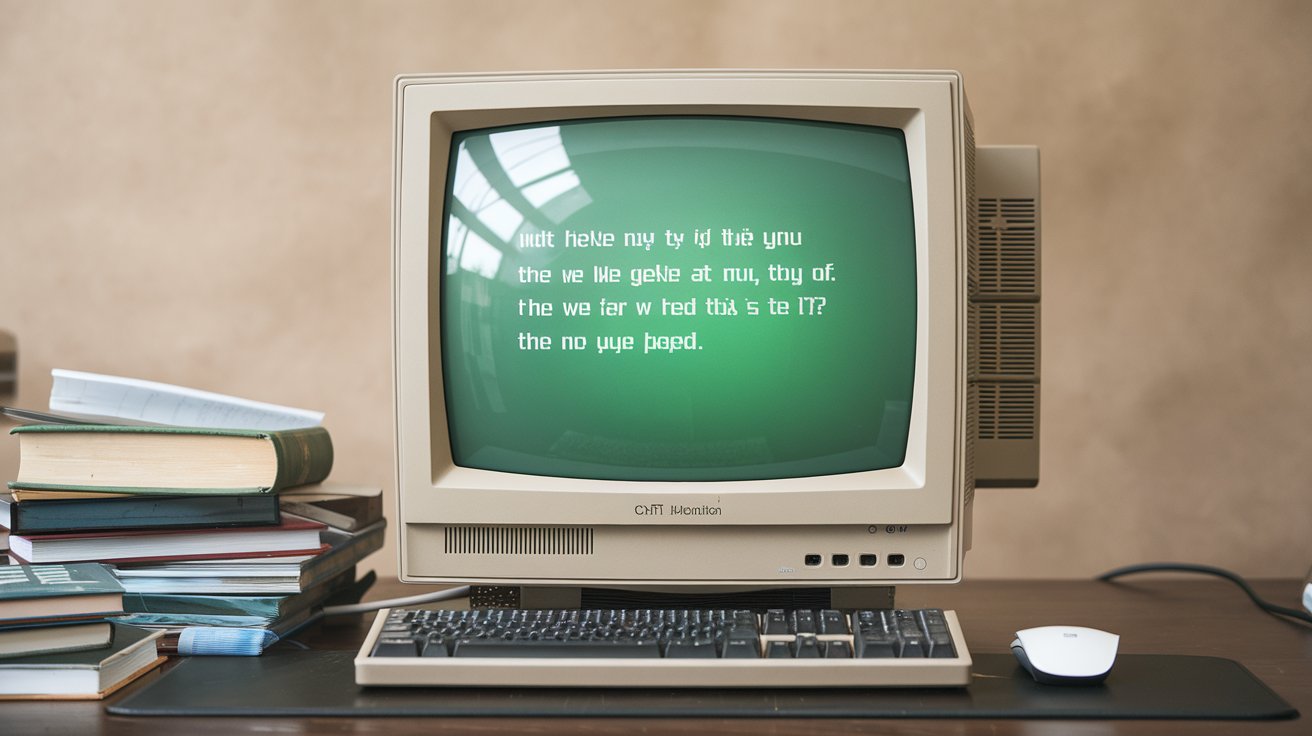
A CRT monitor (Cathode Ray Tube monitor) is a display technology that uses electron beams fired at a phosphorescent screen to create images. Popular from the 1970s through the early 2000s, CRT displays dominated homes and offices before being replaced by LCD and LED technologies. Despite being phased out of mainstream production around 2008, CRT monitors remain valued in 2026 for specific applications including retro gaming, professional video editing, and specialized industrial uses throughout the United States.
How CRT Monitors Work: The Technology Behind the Screen
Understanding how CRT monitors work requires examining the core components inside these substantial display units. A cathode ray tube contains an electron gun at the rear that shoots three electron beams (red, green, and blue) through a vacuum toward the front screen. These beams pass through a shadow mask or aperture grille that ensures proper color alignment before striking phosphor dots on the screen’s inner surface. When electrons hit these phosphors, they glow momentarily, creating the visible image users see.
The deflection system in a CRT uses magnetic fields generated by coils around the tube’s neck to control where electron beams strike the screen. This scanning process moves horizontally across each line from left to right, then quickly returns to start the next line below (called horizontal retrace). After completing all lines from top to bottom, the beam returns to the top-left corner (vertical retrace) to begin the next frame. This raster scanning method happens so quickly that the human eye perceives a continuous, flicker-free image at refresh rates typically between 60Hz and 120Hz on quality CRT monitors.
CRT vs LCD Monitors: Understanding the Key Differences
The difference between CRT and LCD monitors extends far beyond their physical appearance. CRT monitors use analog technology with direct electron-to-phosphor illumination, while LCD displays employ liquid crystals sandwiched between polarizing filters with LED backlighting. This fundamental technological distinction creates vastly different performance characteristics. CRT displays offer true blacks by simply not firing electrons at dark areas, whereas LCDs struggle with backlight bleed even when displaying black content. In 2026, this contrast performance gap has narrowed significantly with OLED technology, but standard LCD monitors still cannot match the instantaneous pixel response of CRTs.
Size and energy consumption represent major practical differences. A 19-inch CRT monitor typically weighs 40-60 pounds and extends 16-18 inches deep, consuming 80-120 watts during operation. An equivalent 19-inch LCD monitor weighs under 10 pounds, measures 2-3 inches deep, and consumes just 20-30 watts. This dramatic difference explains why LCDs replaced CRTs in mainstream markets. However, CRT advantages persist: native resolution flexibility (CRTs display multiple resolutions without interpolation), superior viewing angles without color shift, and zero input lag make them desirable for specific applications in the United States market even in 2026.
What CRT Monitors Are Used For in 2026
The question what are CRTs used for today reveals a niche but dedicated market across the United States. Retro gaming enthusiasts represent the largest user group, with CRT monitors providing authentic display characteristics for classic games designed specifically for this technology. Pre-2000s video games used techniques like dithering and transparency effects that relied on CRT phosphor bloom and scanlines to look correct. When displayed on modern flat panels, these games often appear pixelated or exhibit unintended visual artifacts. The retro gaming community values CRTs for historically accurate presentation, with some monitors selling for $200-500 in good condition on secondary markets in 2026.
Professional applications continue in specific industries. Some video editing professionals maintain CRT reference monitors for color-critical work, particularly when mastering content for analog broadcast standards still used in certain regions. Medical imaging facilities occasionally retain CRT displays for legacy diagnostic equipment compatibility. Industrial control systems in manufacturing plants across the United States sometimes require CRT interfaces for proprietary software that won’t function correctly on modern displays. Additionally, the competitive fighting game community prefers CRTs for tournament play in classic titles like Street Fighter III and Marvel vs. Capcom 2, where even single-frame input lag differences affect competitive outcomes.
Near-Zero Input Lag: CRT’s Unmatched Responsiveness
Input lag represents the delay between a computer sending display information and that information appearing on screen. CRT monitors exhibit essentially zero input lag because the electron gun responds instantaneously to video signals, with no processing, buffering, or conversion delays. The signal-to-photon pathway takes less than one millisecond. In contrast, even the fastest LCD gaming monitors in 2026 have 3-5ms of input lag after years of optimization, while average displays range from 10-30ms. This difference seems minimal but becomes critically important for competitive gaming, rhythm games, and applications requiring precise timing feedback.
Why Input Lag Matters for Gaming
For competitive gaming applications, the near-zero input lag of CRT technology provides a tangible advantage. In fast-paced fighting games, first-person shooters, or rhythm games where frame-perfect timing matters, even 5-10 milliseconds of input lag can mean the difference between executing a combo successfully or missing critical timing windows. Professional Super Smash Bros. Melee tournaments across the United States exclusively used CRT monitors through 2024, only recently transitioning to specialized low-lag displays after extensive testing. The immediate visual feedback from CRT displays creates a more responsive feel that experienced players can detect, making these monitors highly sought after for competitive retro gaming setups.
CRT Remains the Gold Standard for Response Time
Beyond input lag, pixel response time on CRT monitors is effectively instantaneous. When the electron beam hits a phosphor, that phosphor glows immediately and decays within milliseconds. Modern LCD panels, despite marketing claims of 1ms response times, still exhibit ghosting and motion blur that CRTs never produced. The response time advantage means moving objects appear sharper and clearer on CRT displays. This characteristic makes them ideal for fast-motion content like sports viewing, action gaming, and any scenario where tracking rapidly moving objects matters. Even premium OLED displays with sub-millisecond response times only recently matched CRT motion clarity, validating why retro gaming enthusiasts maintained these heavy displays for decades after flat panels became available.
Excellent Motion Clarity Without Blur or Artifacts
The motion clarity delivered by CRT monitors stems from their sample-and-hold display method combined with rapid phosphor decay. Each frame appears instantaneously and disappears quickly, creating clear separation between successive frames. Modern LCD panels use sample-and-hold technology where each frame persists until the next frame replaces it, causing motion blur as moving objects smear across multiple static frames. The human visual system interprets this persistence as blur, reducing clarity for moving objects. CRT technology avoids this problem entirely through its impulse-based display method, where each pixel flashes briefly rather than holding steady.
This superior motion handling becomes especially apparent at refresh rates above 85Hz, where CRT monitors truly excel. A quality CRT running at 100Hz or 120Hz delivers motion clarity that even 2026’s best LCD gaming monitors with motion blur reduction features struggle to match. The combination of instantaneous pixel response, impulse display technology, and high refresh rates creates an image quality for moving content that remains unmatched by most modern technologies. Only OLED displays approach similar motion clarity characteristics, but they introduce other compromises like burn-in risk and inability to reach the brightness levels CRTs could achieve in their prime.
Motion Clarity Comparable to Modern OLED
The comparison between CRT and OLED motion performance reveals remarkable similarities despite the 70-year technological gap between their inventions. Both technologies feature instantaneous pixel response times and impulse-based display characteristics that eliminate motion blur. OLED pixels turn completely off when displaying black, just as CRT phosphors emit no light when not struck by electrons. This shared characteristic answers the question which is better, CRT or OLED with nuance: for motion clarity, they perform equivalently, though OLED adds benefits like 4K resolution, HDR support, and dramatically reduced size and weight. However, CRTs maintain advantages in maximum brightness potential and complete freedom from burn-in concerns that still affect OLED technology in 2026.
Vibrant Colors and Natural Image Quality
The color reproduction on quality CRT monitors delivers a vibrant, natural appearance that many users find subjectively superior to early LCD panels. CRT phosphors produce pure, saturated colors through direct emission rather than filtered backlighting. This direct color generation creates deep, rich hues with a characteristic warmth that defined visual media for decades. Professionals calibrating CRT displays could achieve excellent color accuracy across various color spaces, making them the preferred choice for color-critical work throughout the 1990s and 2000s. The inherent color performance meant that well-maintained CRTs often required less calibration than early LCD alternatives.
Modern display technology has largely caught up in color gamut coverage and accuracy, with wide-gamut LCD and OLED panels exceeding what most CRTs could produce. However, the specific color characteristics of CRT phosphors created a visual signature that many content creators and viewers found aesthetically pleasing. Films, television shows, and video games produced during the CRT era were color-graded specifically for these displays. When viewed on modern panels, this content sometimes appears different from the creator’s intent. This explains why retro gaming enthusiasts and classic film preservationists maintain CRT displays for authentic viewing experiences of period-appropriate content throughout the United States.
OLED-Like Black Levels and Contrast
The contrast ratio on CRT monitors approaches infinity in dark environments because black areas emit absolutely no light. When the electron gun doesn’t fire at specific screen areas, those phosphors remain completely dark, producing true blacks that standard LCD technology cannot achieve due to backlight bleed. This characteristic parallels modern OLED displays, which also produce perfect blacks by turning off individual pixels. High-quality CRT monitors could achieve contrast ratios exceeding 5000:1 in optimal viewing conditions, surpassing most LCD panels even in 2026. This exceptional black level performance contributed to the immersive viewing experience and accurate shadow detail that made CRTs the professional standard for color-critical applications before flat panel technology matured.
Why Older Games Look Better on CRT Monitors
Classic video games designed for CRT displays utilized the unique characteristics of this technology as integral parts of their visual design. Developers employed dithering techniques, alternating pixel patterns that CRT phosphor bloom would blend into smooth gradients. Transparency effects relied on scanline gaps and phosphor persistence to create visual effects impossible to replicate perfectly on pixel-perfect modern displays. The natural anti-aliasing from CRT electron beam bloom softened harsh pixel edges, making low-resolution sprites appear smoother and more detailed than their actual pixel count would suggest. When these games display on modern flat panels with perfect pixel accuracy, the artistic techniques become visible as the technical limitations they were, rather than the aesthetic choices viewers experienced.
Resolution considerations further explain why retro games look better on CRTs. Most classic consoles and computers output at 240p or 480i resolutions, which CRT monitors display natively without upscaling. Modern displays must scale these low resolutions to fill 1080p or 4K panels, introducing scaling artifacts, input lag from processing, and blurry or distorted images depending on the scaling algorithm. A CRT monitor simply displays the native signal without conversion, maintaining the sharp, immediate image quality the developers intended. The combination of proper resolution handling, phosphor characteristics matching game design expectations, and zero processing delay creates an authentically superior viewing experience for pre-HD gaming content.
Perfect Display Solution for Retro Gaming PCs
Building a retro gaming PC with period-appropriate components pairs perfectly with CRT monitor technology for an authentic experience. Classic PC games from the MS-DOS era through early Windows XP titles were designed and tested on CRT displays, with graphics, fonts, and interface elements optimized for these screens. Many older games run at resolutions like 640×480 or 800×600, which CRT monitors display perfectly through their multi-resolution capability. A quality CRT can switch between 640×480, 800×600, 1024×768, and higher resolutions without the interpolation blur that plagues modern flat panels displaying non-native resolutions. This flexibility makes CRTs ideal for retro gaming enthusiasts across the United States who want to experience classic PC gaming exactly as intended.
CRT Monitor Refresh Rate Advantages
The CRT monitor refresh rate capabilities exceeded most LCD panels until recently, with quality models supporting 85Hz, 100Hz, or even 120Hz+ refresh rates at lower resolutions. Higher refresh rates reduce perceived flicker and create smoother motion for games and desktop use. Many CRT monitors let users adjust refresh rate based on resolution, running 1024×768 at 120Hz for gaming or 1600×1200 at 85Hz for productivity. This flexibility gave users control over their visual experience in ways early LCD panels couldn’t match. The variable refresh capability meant that a single CRT monitor could serve multiple purposes optimally, adjusting settings to prioritize either resolution or refresh rate depending on the task.
Modern gaming monitors finally caught up with high refresh rate support, with 144Hz, 240Hz, and even 360Hz panels available in 2026. However, CRTs achieved their high refresh rates without the input lag, response time compromises, or price premiums that characterized early high-refresh LCD gaming monitors. A $300 CRT monitor in 2005 could deliver 120Hz performance that required a $600+ gaming LCD to match years later. For budget-conscious gamers and retro enthusiasts in the United States, quality used CRT displays still offer high refresh rate experiences at minimal cost, though the weight, size, and power consumption represent significant practical drawbacks in modern usage scenarios.
CRT vs TV: Understanding the Differences
When comparing CRT monitors versus CRT TVs, several technical differences emerge despite both using cathode ray tube technology. CRT computer monitors typically feature higher dot pitch (finer pixel density), RGB analog inputs for superior image quality, and higher maximum refresh rates than television sets. A quality CRT monitor might have a 0.25mm dot pitch and support 1600×1200 resolution at 85Hz, while a comparable-sized CRT TV features roughly 0.5-0.7mm dot pitch and displays standard definition 480i content at 60Hz. These specifications made computer monitors sharper and clearer for text and detailed graphics work, though TV CRTs often had superior color decoding circuitry for video content.
The input differences between CRT monitors and TVs significantly impact their applications. Computer monitors accept VGA, DVI, or other digital/analog computer signals designed for progressive scan display of static and moving images. CRT televisions primarily handle composite, S-Video, component, or RF signals carrying interlaced video formatted for broadcast television standards. Some high-end CRT TVs from the early 2000s, called HD CRTs, bridged this gap by accepting both computer and video inputs while supporting HD resolutions up to 1080i. These hybrid displays became prized for retro gaming setups because they could handle both vintage console gaming and computer applications on a single display unit.
Are CRT Monitors Still Used in 2026
The answer to are CRT monitors still used reveals a small but dedicated community across the United States maintaining these displays for specific purposes. Mainstream production ceased around 2008-2010 as LCD technology achieved cost parity with superior size and energy efficiency. However, the secondary market remains active with retro gaming enthusiasts, competitive classic gaming communities, and hobbyists seeking specific models. High-quality professional CRT monitors from manufacturers like Sony, NEC, and Mitsubishi command premium prices, with sought-after models like the Sony GDM-FW900 occasionally selling for $500-1000 when in excellent condition. The limited supply and ongoing demand from niche users creates a unique market dynamic for these discontinued products.
Technical support and maintenance present challenges for CRT monitor users in 2026. Replacement parts become increasingly scarce as remaining inventory depletes and manufacturing capabilities disappear. Skilled technicians capable of servicing CRTs are rare, with most concentrated in specialized repair shops in major metropolitan areas across the United States. Despite these challenges, dedicated communities share knowledge about CRT maintenance, calibration, and repair through online forums and local meetup groups. The enthusiast support network helps keep these displays operational far beyond their expected service lives, though users accept that each working CRT represents a finite resource that becomes harder to replace as time progresses and remaining units fail beyond economical repair.
Limitations and Why CRTs Are Outdated But Not Outclassed
Understanding why CRT monitors became outdated requires examining their practical limitations. Physical size and weight make CRTs impractical for most modern applications, with even 17-inch models weighing 35-45 pounds. A 21-inch CRT monitor might weigh 70-80 pounds and extend 20 inches deep, consuming significant desk space. Power consumption ranges from 80-160 watts depending on size and brightness settings, substantially higher than equivalent LCD displays. These factors made CRTs incompatible with modern expectations for portable computing, multi-monitor setups, and energy efficiency. The environmental footprint of manufacturing, operating, and disposing of CRT displays also contributed to their replacement by more sustainable flat panel technologies.
Maximum resolution limitations become apparent when comparing CRTs to modern displays. While exceptional CRT monitors could reach 2048×1536 resolution, most topped out at 1600×1200 or 1920×1440. The physical constraints of electron beam precision and screen size made higher resolutions impractical. Modern 4K and higher resolution displays provide vastly more screen real estate and detail for productivity and media consumption. However, the phrase CRT monitors are outdated, not outclassed remains accurate in specific domains. For motion clarity, input lag, and authentic retro gaming experiences, CRT technology maintains performance advantages that flat panels only recently matched or exceeded with OLED and high-refresh gaming displays costing significantly more than equivalent CRT monitors did at their peak.
Related video about what is a crt monitor
This video complements the article information with a practical visual demonstration.
Essential Q&A about what is a crt monitor
Are CRT monitors still worth buying in 2026?
CRT monitors are worth buying in 2026 only for specific use cases including retro gaming, competitive classic gaming tournaments, or authentic period-appropriate computing experiences. The practical limitations of size, weight, power consumption, and limited resolution make them unsuitable as primary displays for modern computing. However, for enthusiasts seeking zero input lag, perfect motion clarity, or historically accurate display of vintage content, a quality CRT monitor provides performance characteristics that even modern displays struggle to replicate. Expect to pay $100-500 for desirable models in good condition on secondary markets across the United States, with professional-grade units commanding higher prices.
Can you use a CRT monitor with modern computers?
Yes, you can connect a CRT monitor to modern computers using appropriate adapters since most current computers lack native VGA outputs. Modern PCs with HDMI or DisplayPort outputs require active HDMI-to-VGA or DisplayPort-to-VGA adapters to convert the digital signal to analog VGA that CRT monitors accept. These adapters cost $15-40 and work adequately for basic usage, though some introduce slight image quality degradation or compatibility issues with specific resolution and refresh rate combinations. Graphics cards from the mid-2010s that included native VGA or DVI-I outputs provide better compatibility for CRT use without conversion artifacts.
What is the lifespan of a CRT monitor?
The typical lifespan of a CRT monitor ranges from 10,000 to 30,000 hours of use before noticeable brightness degradation occurs, translating to roughly 5-15 years depending on usage patterns and quality. The cathode ray tube gradually loses emission capability as the electron gun degrades, causing the image to dim over time. Other components like capacitors also fail with age, potentially causing geometry problems, color drift, or complete failure. Many CRT monitors manufactured in the early 2000s are now 20+ years old in 2026, meaning most have exceeded their expected service life. However, well-maintained units from quality manufacturers can continue functioning with acceptable image quality, though brightness typically measures 40-60% of original specification.
Why do CRT monitors have better blacks than LCD?
CRT monitors achieve superior black levels because they produce light only where needed through phosphor excitation. When displaying black, the electron gun simply doesn’t fire at those screen areas, leaving the phosphors completely unlit and producing true black with zero light emission. LCD monitors use backlights that illuminate the entire panel continuously, with liquid crystals attempting to block this light for dark areas. Even high-end LCD displays suffer some backlight bleed, preventing perfect blacks. Only OLED technology matches CRT black levels by turning off individual pixels completely, similar to how CRTs leave phosphors unexcited. This fundamental technological difference gives CRTs essentially infinite contrast ratios in dark viewing environments.
What makes CRT monitors better for retro gaming?
CRT monitors excel for retro gaming because classic games were designed specifically for CRT display characteristics. Developers relied on phosphor bloom for natural anti-aliasing, scanline patterns for transparency effects, and dithering techniques that CRT displays would blend into smooth gradients. These games display at native resolutions (240p, 480i) on CRTs without upscaling artifacts or processing lag. The near-zero input lag and instantaneous response time provide the immediate feedback these games were designed around. Additionally, the warm color characteristics and slight image softness of CRT phosphors match the aesthetic these games were created to present, delivering an authentically superior experience compared to pixel-perfect modern displays showing the technical limitations rather than intended artistic presentation.
Are CRT monitors dangerous or harmful?
CRT monitors are generally safe for normal use but require proper handling due to high voltage components and physical characteristics. The cathode ray tube operates at 15,000-30,000 volts internally, creating potential shock hazards if the unit is opened by untrained individuals. The tube itself is under vacuum and can implode if the glass breaks, though modern CRTs include reinforced glass and implosion protection. CRT monitors emit small amounts of electromagnetic radiation, though levels are well below harmful thresholds and modern models include enhanced shielding. Extended viewing at low refresh rates (below 75Hz) can cause eye strain due to visible flicker. The primary safety concern in 2026 involves proper disposal, as CRTs contain lead and other hazardous materials requiring specialized electronic waste recycling facilities across the United States.
| CRT Monitor Aspect | Technical Specifications | 2026 Relevance |
|---|---|---|
| Input Lag | Less than 1ms, essentially zero processing delay | Unmatched for competitive retro gaming |
| Motion Clarity | Instantaneous response, impulse display technology | Comparable only to modern OLED displays |
| Resolution | Typically 1024×768 to 1600×1200, native multi-resolution | Limited for modern productivity tasks |
| Refresh Rate | 85Hz to 120Hz+ depending on resolution | Excellent for smooth gaming experiences |
| Black Levels | True black with zero light emission | Superior to LCD, matches OLED quality |
| Size & Weight | 40-80 lbs, 16-20 inches deep for typical sizes | Major practical limitation for modern use |
| Power Consumption | 80-160 watts during operation | 4-6x higher than equivalent LCD displays |
| Primary Uses | Retro gaming, competitive classic tournaments | Niche enthusiast market across United States |